The Sleeping Fox
A Fox Curled Up to Sleep
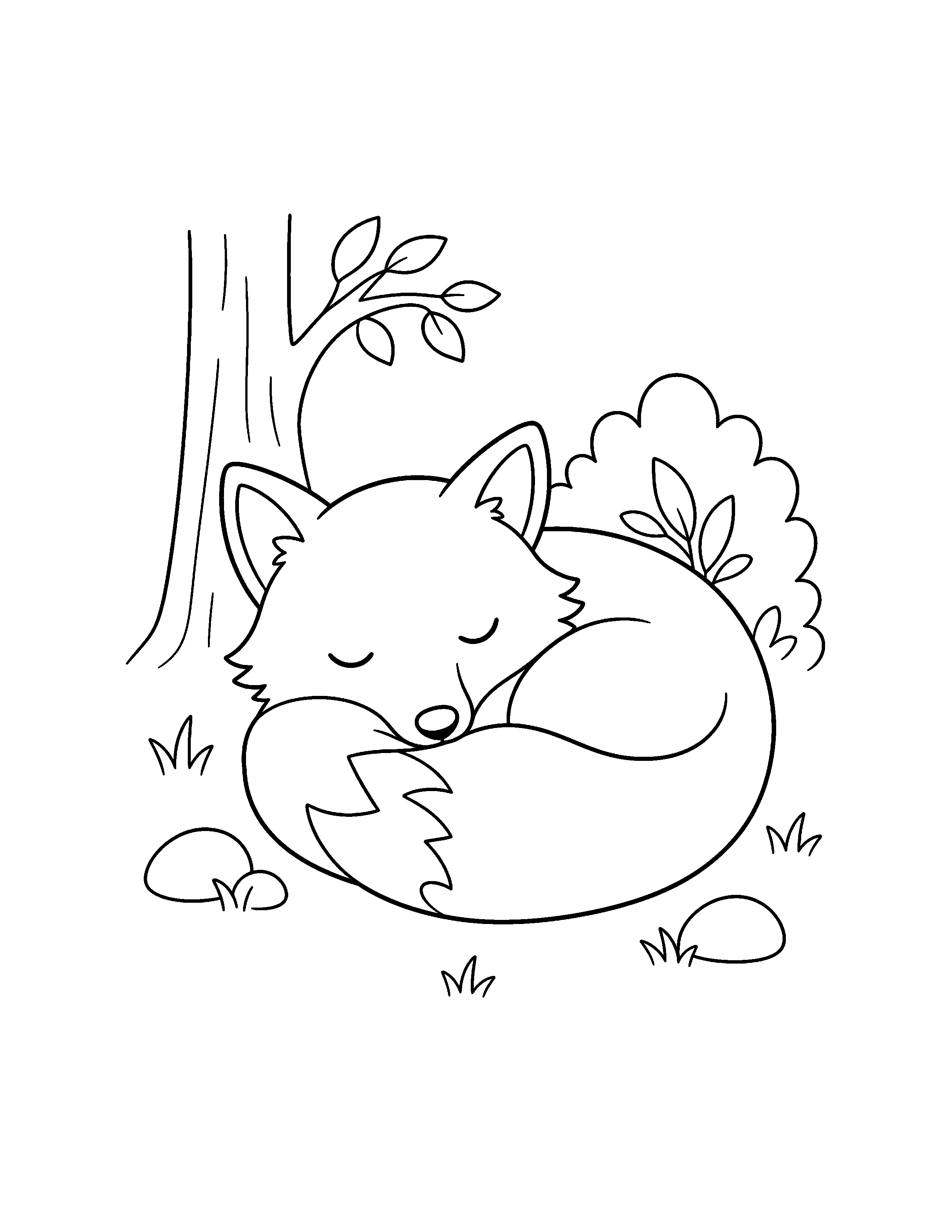
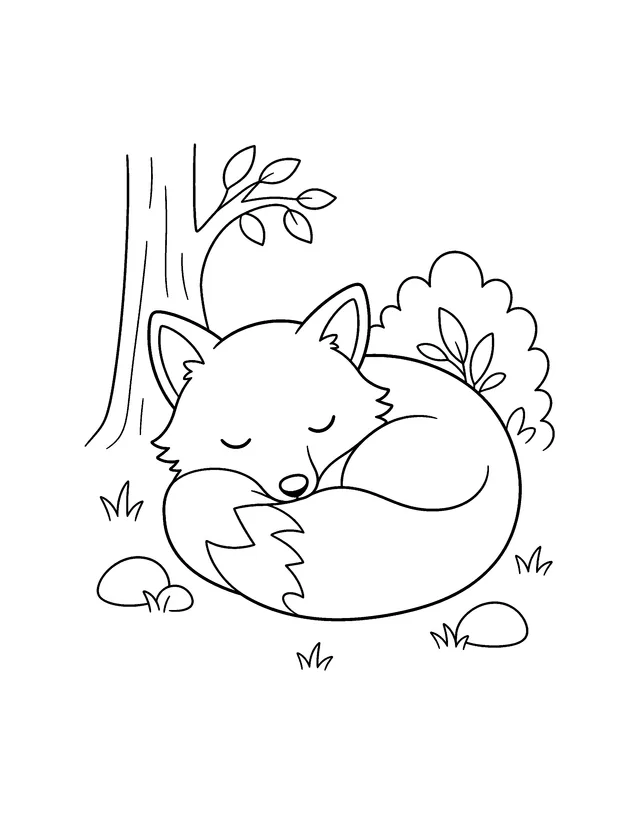
This printable centers on one fox curled into a compact resting pose. Its closed eyes, lowered head, pointed ears, small oval nose, and large tail make the quiet action readable before any color is added.
The body and bushy tail form one rounded foreground shape, with the tail sweeping around the fox and ending near its face. A zigzag boundary marks the broad tail tip, creating a clear region that can contrast with the rest of the fur.
Follow the main silhouette from the upper ear around the back, along the outer tail curve, and back toward the muzzle. That continuous path makes the curled pose easy to understand, while the closed eyelids and low head keep attention on the fox's resting expression.
Tree, Leaves, Bushes, and Ground
A tall tree trunk frames the viewer's left side and sends one branch across the space above the fox. Five outlined leaves hang from and rise above that branch, adding small shapes without covering the sleeping animal.
On the viewer's right, rounded bushes and a leafy stem rise behind the fox's back. Grass tufts and smooth stones sit lower around the resting figure, so the ground has several separate accents while the fox remains the largest object. The bush contours stop behind the back and tail instead of crossing the fox's main outline, which keeps the foreground shape intact.
Read the scene in layers: curled fox in front, bushes immediately behind it, then the taller trunk and overhead branch. This order helps keep adjacent greens or browns distinct and preserves the strong contrast between the main animal and its simple forest frame.
Fox and Forest Colors
Color Ideas for the Fox and Forest
Try a warm orange, russet, golden brown, or soft gray across the fox's broad body and tail. The pointed ears, muzzle area, and separated tail tip can use paler tints, while the nose can take a deeper neutral color.
For the tree, choose one medium brown for the trunk and a darker brown along one edge or inside the narrow bark lines. The five branch leaves can alternate between yellow-green, leaf green, and deep green without requiring any particular season.
Use related greens for the rounded bushes and small leafy stem, then shift the grass tufts slightly lighter or darker so they remain visible against the open ground. Gray, tan, or muted brown can separate the rounded stones from both foliage and fox fur.
A limited palette can emphasize the peaceful composition: one main fox color, one lighter accent for the muzzle and tail tip, two greens for plants, and one brown for wood. Because the outlines contain no gray shading, pressure changes can add gentle depth without hiding the clean boundaries.
Finish the Printable
A Calm Center-Out Coloring Order
Begin with the fox's largest closed areas: body, outer tail, and broad tail tip. Move next to the ears, muzzle, and nose, taking care around the closed eyelids and the short contours where the head meets the tail.
After the fox, fill the tree trunk and rounded bushes, then work through the branch leaves and smaller leafy stem. Finish the forest frame with the grass tufts and stones, which are isolated around the lower edge and can be colored without crossing the main silhouette.
Broad crayons or pencils can cover the body, tail, trunk, bushes, and stones efficiently. A sharpened colored pencil is useful for the eye curves, narrow ear interiors, leaf points, grass tips, nose edge, and zigzag tail boundary after the larger regions are complete.
Large Shapes with a Few Small Accents
The approved Simple · Ages 3–6 label matches the single large fox, bold outlines, compact pose, and broad regions in the body, tail, tree, bushes, and stones. The page stays readable because the forest elements frame rather than overlap the main subject.
Colorists who want a quicker pass can complete the fox, trunk, and bushes first. Those ready for more control can continue into the five leaves, grass tufts, facial contours, ear interiors, nose, and tail-tip boundary, all of which add detail without crowding the page.