Meet the Farm Calf
About This Calf Farm Coloring Page
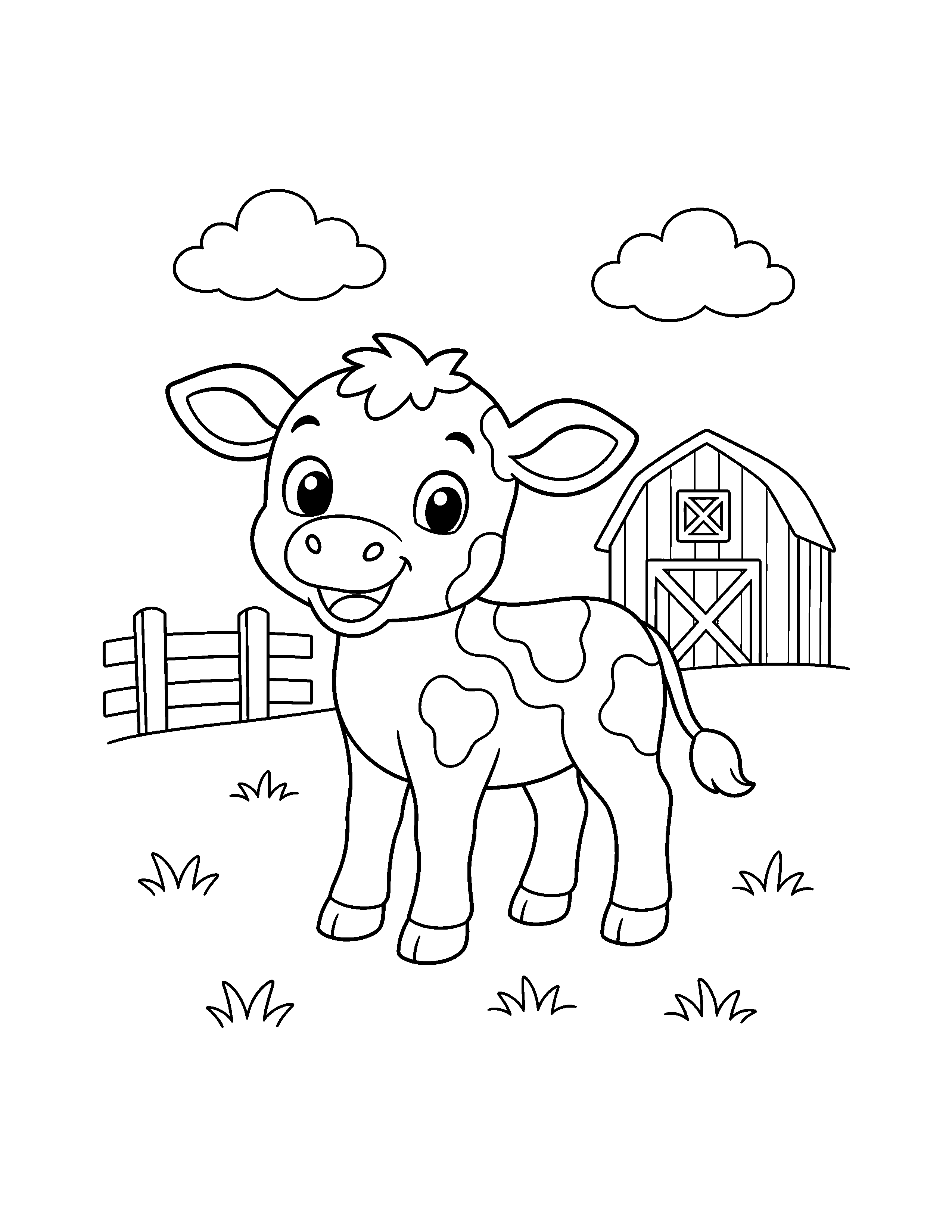
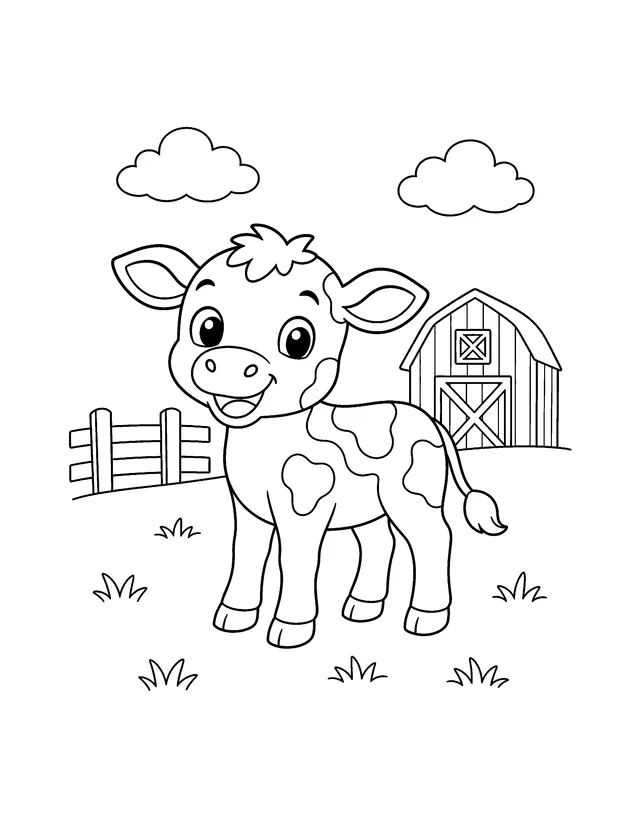
This printable shows one young calf standing on all four legs in front of a simple farm backdrop. The complete animal fills the center of the page, while a short fence appears behind it on the left and one small barn sits behind it on the right.
Large ears, a small hair tuft, wide eyes, a broad muzzle, two nostrils, hooves, and a tufted tail make the calf easy to identify. Its open smile and slightly turned face give the standing pose a friendly expression without adding another character.
Several irregular spots break up the calf's broad torso and upper legs. Because the spots are enclosed by strong outlines, they can be colored separately from the body or left as lighter patches while the animal remains the largest focal point.
Barn, Fence, Clouds, and Grass
The barn has a peaked roof, vertical wall boards, one wide double door, and a smaller opening above it. Crossed braces divide both openings into clear geometric sections, giving the compact building more detail than its size first suggests.
On the opposite side, the visible fence segment uses three upright posts and several horizontal rails. The calf overlaps part of the fence and barn, which keeps those objects in the background and leaves the animal's full four-legged stance readable.
Two rounded clouds occupy the open area above the farm objects. Six small grass tufts and one curved ground line sit lower on the page, linking the calf, fence, and barn without filling the white background with extra scenery.
Choose Farm Colors
Colors for the Calf and Farm
Try cream, pale tan, soft gray, or warm brown across the calf's body, then fill the irregular spots with a deeper contrasting shade. A lighter muzzle and ear interiors can separate the face from the hair tuft, eyes, nostrils, and smiling mouth. Repeating the spot color on the hooves or tail tuft can connect the four legs to the rear of the body, while leaving a narrow lighter area around the wide eyes keeps the face readable.
For the barn, a red, blue, green, or natural brown wall color can be paired with a darker roof and lighter doors. Repeating one trim color inside the crossed braces and along the vertical boards helps the smaller building read clearly behind the calf.
The fence can use a quiet wood tone so it does not compete with the animal, while the grass tufts can repeat one or two greens. Leaving the clouds white or giving them a pale blue edge keeps the upper background open around the calf and barn.
Color Large and Small Areas
A Calf-First Coloring Order
Start with the calf's broad head, muzzle, torso, and four legs, then return to the spots, ears, hooves, and tail. Working from the largest body regions toward the small facial features keeps the central animal organized.
Move next to the barn roof and walls before filling the doors, upper opening, braces, and narrow siding sections. The crossed shapes can share one accent color, or each enclosed section can receive a slightly different tone for more visible structure.
Finish with the fence rails, two clouds, grass tufts, and curved ground line. Keeping those background elements lighter than the calf can preserve the size hierarchy that the composition already establishes and maintain clear separation between the foreground animal and the smaller objects behind it.
Simple Shapes with a Few Fine Details
The approved label is Simple · Ages 3–6. The calf's large head, muzzle, torso, legs, and spots provide broad closed regions, and the single central animal is easier to follow than a crowded group scene.
Broad crayons or markers can cover the calf, barn roof, doors, and clouds efficiently. Colored pencils can help with the eyes, nostrils, mouth, hair and tail tufts, hoof edges, narrow barn boards, crossed braces, and small grass shapes.
For a shorter activity, use one body shade, one spot shade, and a single color for each farm object. For a more detailed pass, vary the calf's patches, separate every barn-board section, and add small color changes inside the braces, hooves, and grass tufts.