The Puppy and Its Ball
A Smiling Puppy Beside One Ball
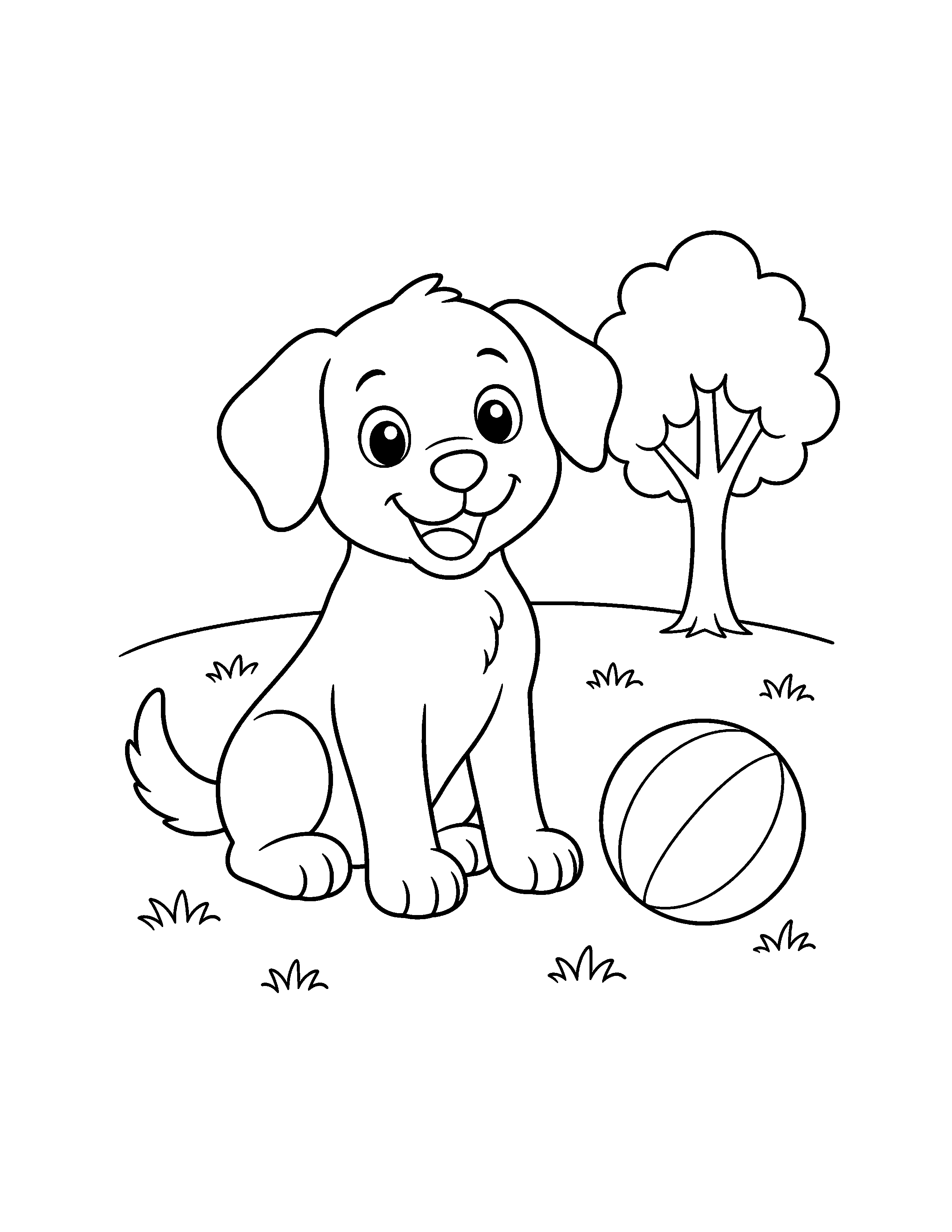
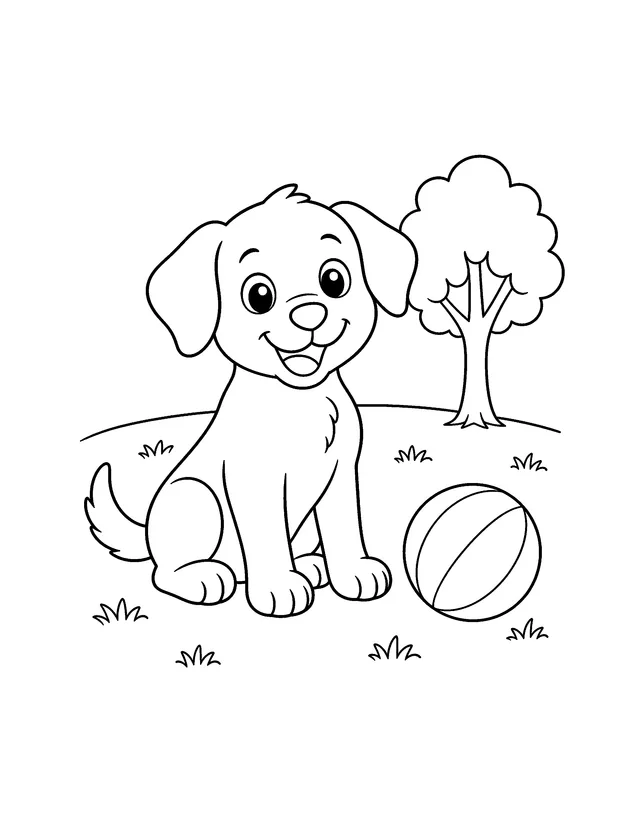
This printable shows one cartoon puppy sitting and facing forward beside a single large ball. Floppy ears, round eyes, a broad nose, four visible paws, and a curved tail create a complete, easy-to-follow animal shape.
The puppy's open-mouth smile and visible tongue give the face a clear expression. Its head sits above a broad seated body, with the front legs reaching down to two paws and the hind legs folding beside them.
Trace the main character from one floppy ear across the rounded head to the other ear, then continue down the torso, paws, hind legs, and tail. This top-to-bottom path keeps the puppy readable before attention moves to the ball and background.
Ball, Tree, and Grassy Ground
The ball rests in the lower-right foreground, separate from the puppy's paws. Two curved lines divide its round outline into three broad panels, giving colorists clear bands that can repeat or alternate colors.
Behind the ball stands one tree with a narrow trunk, branching limbs, and a rounded crown. A curved ground line passes behind the puppy and tree, while small grass tufts are scattered across the foreground and middle ground.
The puppy and ball form the main foreground pair, with the tree placed higher and farther to the viewer's right. Coloring those layers separately can preserve depth: animal first, ball beside it, then tree and grassy ground behind them.
Notice how the curved horizon passes behind the puppy's body and continues toward the tree, while individual grass tufts sit both above and below that line. Keeping the horizon line light and the foreground grass tufts slightly stronger can separate the open ground without adding objects that are not in the drawing.
Choose the Colors
Color Ideas for the Puppy and Ball
Try tan, golden brown, chocolate brown, cream, gray, or black for the puppy's large head and body regions. The floppy ears can match the body or use a deeper shade, while the muzzle and paws can take a lighter tint.
Keep the large eyes bright by coloring around their small white highlights, then choose a dark neutral for the pupils and rounded nose. A soft pink, coral, or muted red can distinguish the visible tongue inside the open smile.
The ball's three panels can use three different hues, an alternating two-color pattern, or one color in light, medium, and dark versions. Because the ball is isolated from the puppy, a stronger palette there can create contrast without obscuring the animal's face.
For the setting, combine a medium brown trunk with one or two greens in the rounded tree crown. The grass tufts can echo those greens, while the open ground may remain white or receive a very light tint that stops at the curved horizon line.
Color Broad Shapes First
A Puppy-First Coloring Order
Start with the puppy's broadest regions: head, ears, torso, front legs, hind legs, and tail. Continue with the lighter muzzle or paw areas, then slow down for the eyes, nose, mouth, tongue, toe lines, and small tail tip.
Move next to the ball, filling its three panels one at a time so the curved dividers stay clean. Finish with the tree crown and trunk, the open ground, and the scattered grass tufts after the two foreground subjects are complete.
Use broad crayon strokes or the side of a colored pencil on the torso, ears, ball panels, and tree crown. A sharpened pencil gives better control around pupils, eye highlights, the mouth edge, tongue, paw toes, branch joins, and pointed grass tips.
Broad Shapes and Friendly Detail
The approved Simple · Ages 3–6 label is supported by one large seated puppy, bold outlines, broad body shapes, three spacious ball panels, and an uncluttered outdoor setting. The face, toes, tail tip, branches, and grass provide a smaller amount of precision work.
For a shorter coloring session, complete the puppy and ball and leave the open ground unfilled. For a fuller pass, add the tree crown, trunk, grass tufts, eye highlights, tongue, toe lines, and panel contrasts while keeping the smiling face as the strongest focal area.