Explore the Butterfly
About This Butterfly and Wildflowers Page
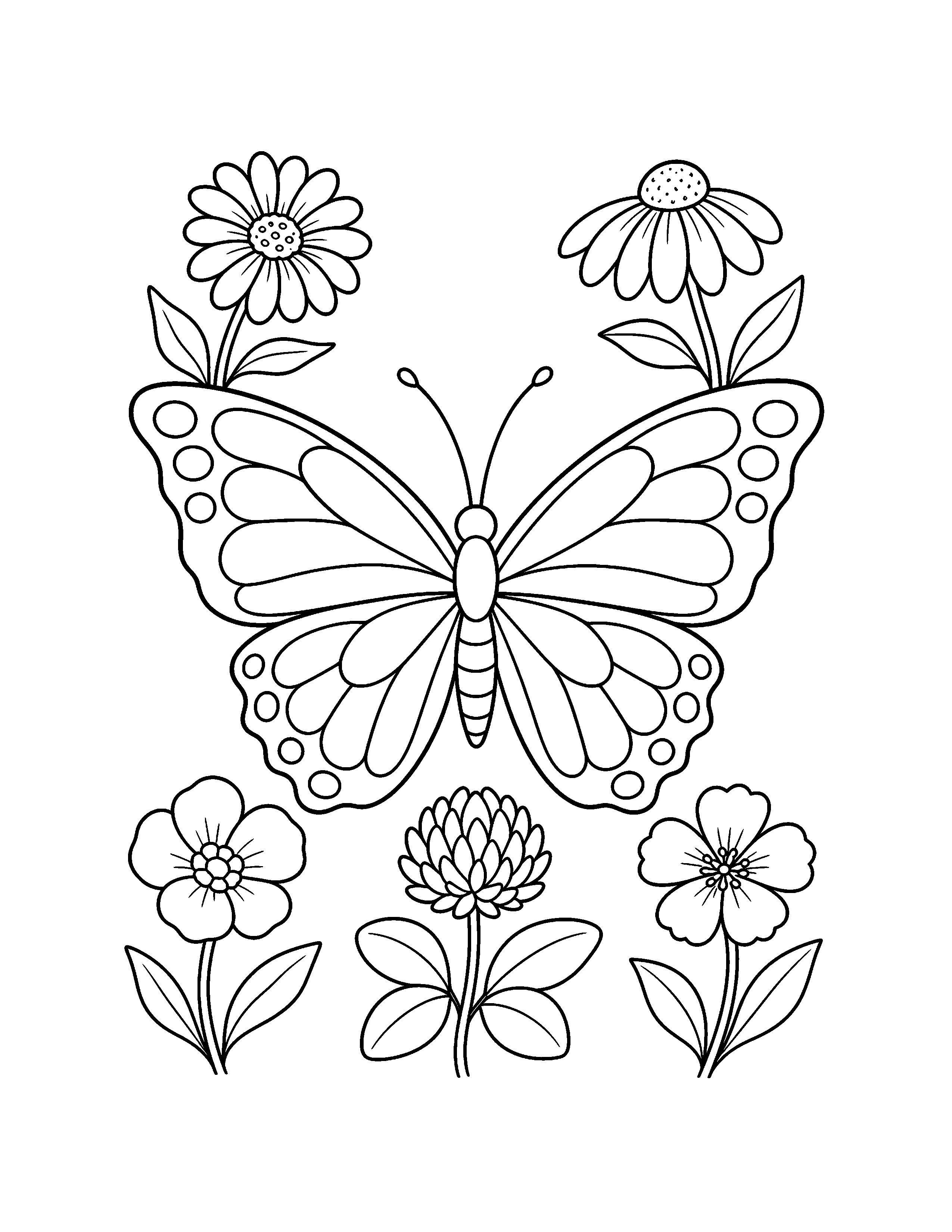
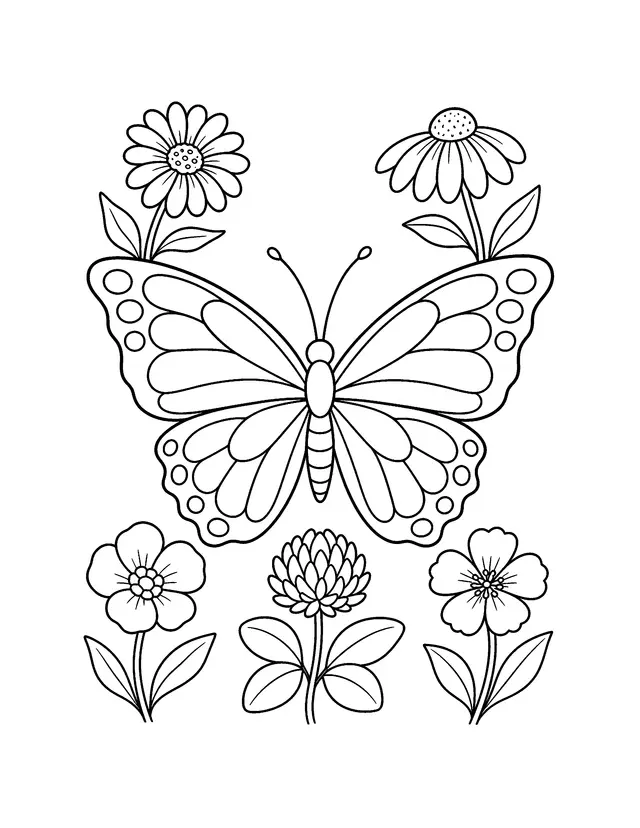
This printable places one large butterfly at the center of five wildflowers. All four wings are fully visible and spread around a vertical body, while two flowers rise above the wings and three more flowers create a lower frame beneath them.
Two antennae with oval tips extend above the rounded head. Below them, an oval thorax and tapered abdomen form the center line, and several curved bands divide the abdomen into clear segments from top to bottom.
The mirrored open-wing pose makes the butterfly the strongest focal area. Large patterned wings fill the middle of the page, yet open white gaps remain between the upper flowers, wing edges, and lower flower clusters so every element stays readable.
Bands, Spots, and Symmetrical Wings
Each upper and lower wing contains broad elongated bands that point away from the butterfly's body. The bands curve with the outer wing edges, creating large repeated sections that can share colors or alternate in a mirrored sequence.
Circular spots sit around the outer portions of all four wings. The upper wings use several differently sized circles, and the lower wings continue the dotted border around their scalloped edges, adding contrast to the longer inner bands.
The left and right patterns closely mirror one another across the body. A colorist can therefore repeat a completed choice on the matching wing section, moving from the inner bands to the outer spots without needing to invent a new arrangement on each side.
Explore the Wildflowers
Five Different Wildflowers
Exactly five flowers surround the butterfly, and their heads are not identical. Some use long rounded petals around dotted centers, others use broad lobed petals and small circular centers, and the lower middle bloom builds its head from several layers of overlapping petals.
Every flower connects to a stem with a pair of pointed leaves, producing ten large leaves across the page. Simple center veins split each leaf into two long coloring areas while narrow stems hold the flower heads above the lower edge.
The two upper blooms remain separate from the wings, and the three lower blooms are spaced as individual clusters. Those white gaps make it possible to give neighboring flowers very different palettes without merging their petals, leaves, or stems visually.
Color Ideas for Wings and Petals
Choose two or three main hues for the wing bands, then repeat the same order on the left and right sides. Violet with coral, blue with yellow, or green with orange can emphasize the mirrored structure while keeping the central body a quieter shade.
The round wing spots can use a single contrasting color or a sequence that changes from top to bottom. Leaving a narrow uncolored gap between the spots and neighboring bands can preserve the bold outlines and keep each repeated shape distinct.
Give each flower its own petal family, such as pink, yellow, blue, orange, or lavender, then use greens for the ten pointed leaves. The different center shapes can carry deeper versions of the petal colors, making the dotted, circular, oval, and layered structures easy to compare.
Color with Symmetry
A Symmetry-First Coloring Order
Start with the head, thorax, and segmented abdomen to establish the vertical center. Then color one upper-wing band and immediately repeat that choice in the matching band on the other side before moving outward.
Continue through the lower wing bands and outer circular spots, pairing left and right sections as you go. Broad crayons or markers suit the large bands, while colored pencils can help around scalloped edges, small spots, antenna tips, and narrow abdomen segments.
Finish with the five flower heads, stems, and leaf pairs. Color the broad petals and leaves first, then return to center dots, overlapping petal gaps, short radiating lines, veins, and narrow stems after the surrounding large areas are settled.
The approved label is Cartoon · All ages. The large wing bands, spots, petals, and leaves offer roomy regions, while the varied flower centers and small body details provide an optional finer challenge inside the same open composition without crowding the central butterfly or the five separate blooms.