Rainbow and Rainy Scene
Hello Kitty Holding an Umbrella Under a Rainbow
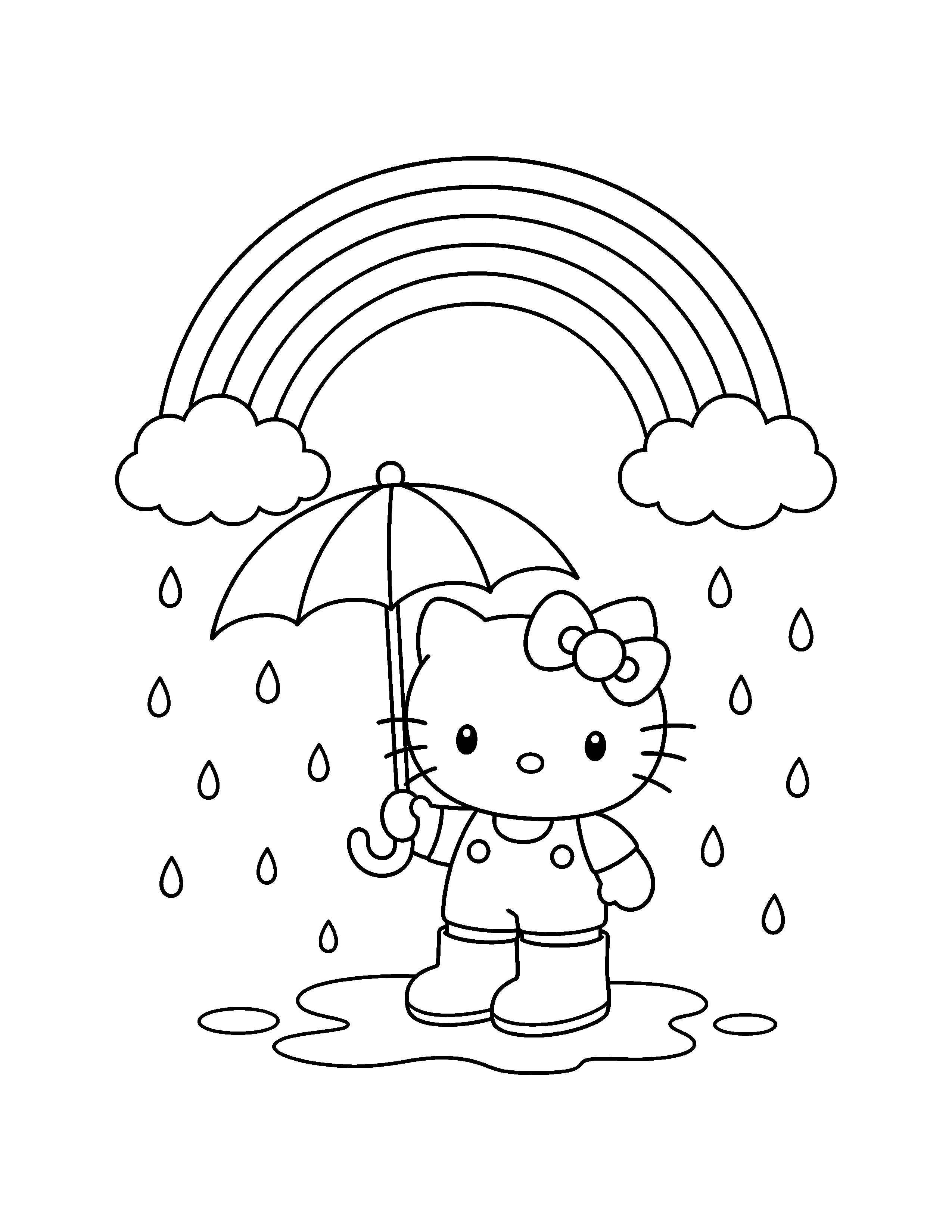
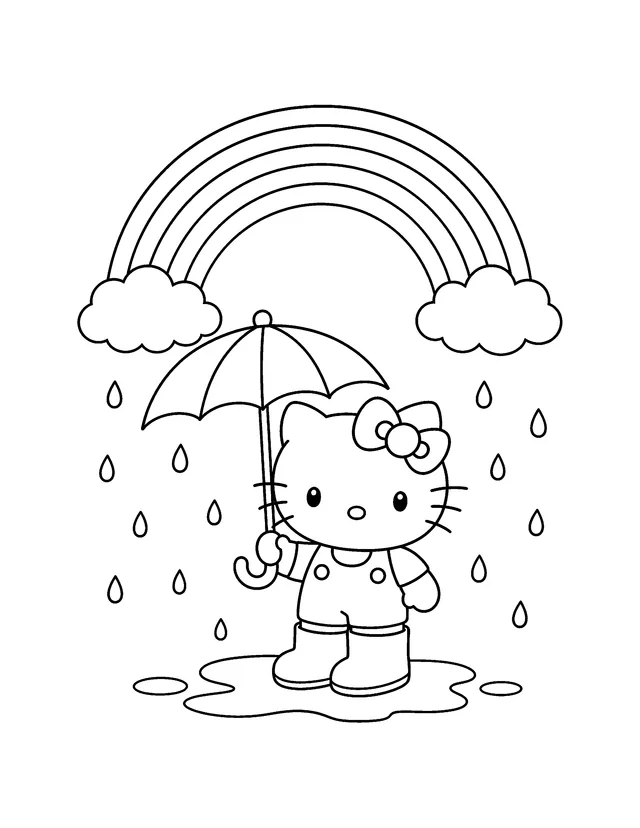
This rainy-day printable shows Hello Kitty standing beneath one open umbrella while a complete rainbow curves across the upper page. Rounded clouds cap both ends of the rainbow, outlined drops fall through the open areas, and puddle shapes spread below the character's pair of rain boots.
The character faces forward with oval eyes, a small oval nose, six whiskers, and one bow above the ear on the viewer's right. A buttoned raincoat covers the body, both boots remain fully visible, and the paw on the viewer's left closes around the umbrella's curved handle.
Three vertical zones organize the drawing. Rainbow and clouds create a wide top frame, the paneled umbrella fills the center, and the raincoat, boots, and puddles anchor the bottom. That order makes the weather elements readable without adding a named place that the line art does not establish.
A Rainbow, Umbrella, and Rainy Ground
The rainbow uses nested curved bands that follow the same broad arch from one cloud to the other. Each cloud uses rounded lobes to close one end of the arch, while the area below the rainbow's center remains open. The repeated arcs provide long color paths with clear black boundaries between neighboring bands.
Below the rainbow, the umbrella canopy forms a separate middle layer. Curved seams divide it into broad panels around the central pole, and the handle bends toward the gripping paw. Raindrops remain outside the canopy, while the face and upper raincoat stay sheltered directly beneath it.
At ground level, the two boots interrupt the largest puddle outline, with additional outlined water shapes nearby. These low, irregular curves contrast with the rainbow's smooth arch and the umbrella's rounded panels. Keeping the puddles lighter than the upper colors can preserve that clear top-to-bottom structure.
Color Planning and Order
Color Ideas for the Rainbow and Rain Gear
The nested rainbow bands can progress through red, orange, yellow, green, blue, and violet, but any ordered palette can work because the source page supplies outlines rather than fixed colors. Apply one hue at a time across the full arch to keep neighboring bands distinct and evenly filled.
For the umbrella, alternate two related colors across the broad canopy panels, such as blue with turquoise or pink with lavender. Echo one of those hues on the raincoat buttons or bow, then choose a stronger contrasting color for the coat and both boots so the standing figure remains prominent.
Pale blue can suggest water in the falling drops and puddles, while leaving the two clouds white with soft blue edges keeps them separate from the paper. A deeper blue near each puddle boundary and a lighter center can add variation without changing any of the confirmed weather shapes.
Color from the Rainbow Down to the Puddles
Start at the top with the long rainbow bands, working from the outer arc toward the inner arc. Complete both clouds next, then move into the umbrella panels. This route follows the page's vertical layout and reduces repeated movement across the character while the largest curved areas are being filled.
Continue with the head, bow, raincoat, sleeves, and boots before coloring the separate raindrops and puddles. The face and umbrella are the main focal pair, so finishing them before the scattered water shapes establishes the central subject and makes the remaining small areas easy to locate.
Use broad strokes inside the rainbow, umbrella panels, head, coat, sleeves, and boots. A sharpened pencil is more precise beside the whiskers, eyes, nose, bow center, curved handle, buttons, pointed raindrops, and irregular puddle edges. Match the tool width to each confirmed boundary instead of pressing harder.
Difficulty and Fine Boundaries
Broad Weather Shapes with Repeated Curves
The approved Cartoon · All ages label is supported by bold contours and generous coloring areas in the rainbow, umbrella, head, raincoat, sleeves, and boots. Repeated rainbow arcs require steady tracking, while the face, handle, coat buttons, individual drops, and puddle edges add smaller precision points.
For a quick version, complete the rainbow, umbrella, coat, and boots, then use one pale blue across every raindrop and puddle. A longer session can alternate canopy panels, vary the rainbow bands, and layer several water tones while preserving the strong black separation around each region.
Finish by checking the narrow spaces beside all six whiskers, the oval eyes and nose, bow center, umbrella pole and handle, round coat buttons, drop tips, and boot edges where they meet the puddle. Those confirmed details benefit from slower marks after the large weather and clothing areas are dry or settled.